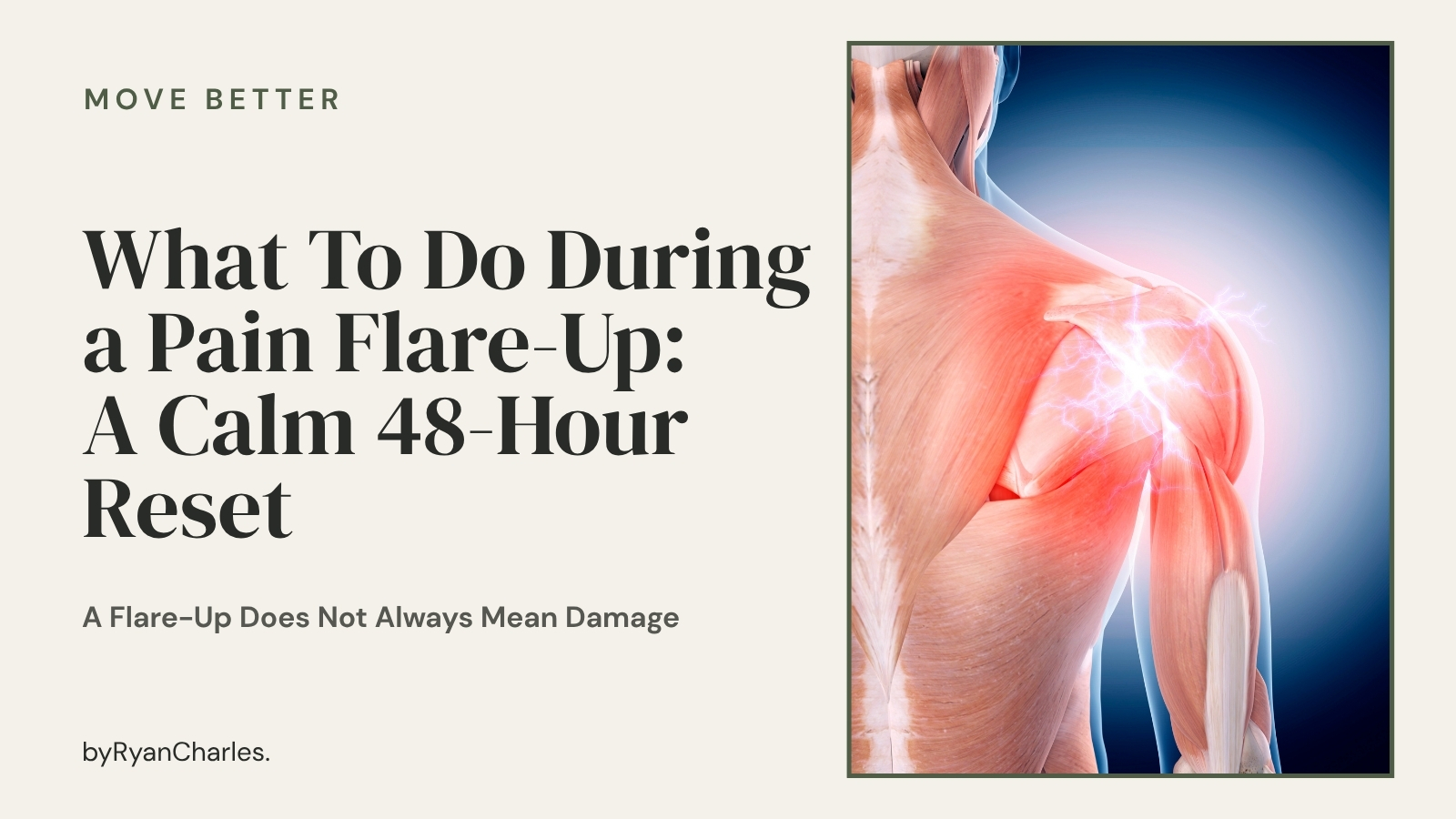
A pain flare-up has a special way of making a normal day feel unnecessarily dramatic.
One minute you’re training, working, walking, gardening, sitting, or simply getting on with life.
The next, your back, knee, hip, neck, shoulder, or tendon has decided to become the main character.
Suddenly, every movement feels suspicious. You start wondering whether you have damaged something, whether you should rest, whether stretching would help, and whether that slightly awkward thing you did on Tuesday has finally returned to collect its debt.
Before you panic-test every movement or disappear into an internet symptom spiral, take a breath.
A flare-up does not automatically mean you have caused new damage.
Often, it means an area has become irritated or more sensitive. Perhaps you did more than your current capacity could handle. Perhaps recovery has been poor. Perhaps sleep, stress, work, training, and general life have quietly formed an administrative committee against you.
The first 48 hours are not about fixing everything.
They are about calming the situation, keeping safe movement in, avoiding the behaviours that tend to make things louder, and gradually rebuilding confidence.
This article covers common musculoskeletal flare-ups—the sort that affect backs, necks, knees, hips, shoulders, tendons, and familiar old injuries.
It is not a substitute for medical care. Severe, unexplained, traumatic, rapidly worsening, or unusual symptoms deserve proper assessment.
First: A Flare-Up Does Not Always Mean Damage
Pain is real.
That should not need saying, but conversations about pain often drift towards one of two unhelpful extremes:
“You must have damaged something.”
Or:
“It’s just in your head.”
Neither is particularly useful.
Pain is influenced by what is happening in the body, but it is also shaped by sensitivity, previous experiences, fatigue, stress, sleep, expectations, fear, and how much load the area has recently handled.
That means pain can increase without a new injury.
An old knee may become sore after a sudden jump in walking. A back can flare after a week of poor sleep, long drives, and one ambitious gym session. A shoulder can become reactive after an activity it normally tolerates—just with less recovery and more total life load surrounding it.
The pain is still real.
It simply is not always an accurate measuring tape for tissue damage.
Think of pain less like a structural report and more like a protective alarm. Sometimes the alarm reflects a serious problem. Often, it reflects an area that currently feels threatened, irritated, or underprepared.
And like any alarm, it can become more sensitive.
That does not mean you should ignore it. It means you should respond intelligently rather than automatically assuming the worst.
Your body may not need rescuing.
It may just need a better dose.
The First Rule: Calm the System, Don’t Keep Testing It
When something hurts, it is remarkably difficult to leave it alone.
You bend again to check.
You twist the other way.
You poke the tender spot.
You repeat the movement that caused the pain, only more cautiously this time, as though your knee may provide a different answer under cross-examination.
It usually does not.
Repeated testing can keep your attention fixed on the area while repeatedly exposing an already irritated system to the movement it currently dislikes.
Your body does not need an interrogation.
It needs a quieter room.
This does not mean becoming frightened of movement. It means stopping the constant checking and choosing a few movements that feel manageable.
Instead of repeatedly asking, “Does this still hurt?” try asking:
- What movement feels easiest right now?
- What position helps the symptoms settle?
- Can I walk comfortably for two or five minutes?
- What can I temporarily reduce without shutting down completely?
- How does the area respond afterwards?
You are trying to lower the volume, not demand instant silence.
The First 24 Hours: Reduce the Irritant, Keep Gentle Movement
The first day is usually about relative rest.
That means temporarily reducing activities that clearly aggravate the problem while continuing with movement you can tolerate.
It does not mean bed rest, complete shutdown, or entering a committed long-term relationship with the couch.
Reduce the obvious trigger
Start with whatever is clearly winding symptoms up.
That might mean:
- pausing heavy lifting
- shortening a walk
- reducing repeated bending
- changing position more often at work
- skipping a hard training session
- avoiding one particularly aggravating movement
- breaking a large task into smaller pieces
The important word is temporarily.
You are adjusting the dose, not declaring the movement dangerous for the remainder of your natural life.
Reducing something for a day or two is not weakness.
It is load management.
Keep some movement in
For many common flare-ups, gentle movement is preferable to staying completely still.
Depending on the painful area, this might include:
- a short, easy walk
- regular position changes
- light household movement
- slowly bending and straightening a joint through a comfortable range
- relaxed shoulder or neck movements
- getting up regularly if you have been sitting
- several small amounts of movement spread across the day
The benefit is not that movement magically cures pain.
It helps maintain function and can reduce the stiffness, guarding, and loss of confidence that often accompany complete shutdown.
The dose matters.
A ten-minute walk that leaves you noticeably worse for the rest of the afternoon was probably too much for that moment.
A three-minute walk that feels slightly stiff but settles shortly afterwards may be a much better starting point.
This is not about doing as much as possible.
It is about finding what your body currently tolerates.
Use comfortable positions
You are allowed to get comfortable.
This should not be controversial, yet people sometimes believe the only “correct” response to pain is to force perfect posture or maintain one supposedly therapeutic position for hours.
There is no medal for sitting upright while quietly suffering.
Find positions that help the system settle. Use pillows, back support, arm support, or changes between sitting, standing, and lying if they help.
You do not need to find one perfect posture and guard it like a state secret.
The best position is often your next position.
Use heat or ice if they help
Heat and ice are comfort tools.
They are not magical tissue-healing technologies, and neither one wins an international award for being universally correct.
Heat may help an area feel less guarded or stiff. Ice may temporarily reduce pain for some people. Others strongly dislike one or both.
Use whichever feels helpful, protect your skin, and remember what the tool is for: making you comfortable enough to rest or move more easily.
It is assistance.
It is not the entire recovery plan.
Protect the boring basics
A flare-up is not the ideal time to forget food, water, sleep, and every other unglamorous part of being a functioning mammal.
Try to:
- eat normally
- stay hydrated
- protect your sleep where possible
- reduce unnecessary stress around the pain
- keep your day reasonably predictable
- avoid making six desperate treatment changes at once
The basics are not exciting.
Neither is making an irritated knee worse because you slept four hours, skipped lunch, and spent the evening researching obscure cartilage procedures.
Boring helps.
The Next 24 Hours: Rebuild Safe Movement
If symptoms have started to settle—or have at least stopped escalating—the next step is to gently expand what you are doing.
Not much.
Just enough.
You might add:
- slightly longer walks
- a few gentle mobility movements
- light household tasks
- easy bodyweight movements
- simple practice related to your normal activity
- several short “movement snacks” through the day
If your knee is sore, that might mean a few controlled sit-to-stands from a higher chair.
If your back has flared, it might mean practising a small, comfortable hip hinge. If it’s specifically your lower back that’s flared up, I’ve written a separate guide on what to do during a back pain flare-up
If your shoulder is reactive, it might mean gently moving the arm through the range it currently tolerates rather than pinning it to your side all day.
The goal is not to force normal movement immediately.
The goal is to choose movements your body forgives afterwards.
Safe, tolerable, and no worse afterwards.
That does not always mean completely pain-free.
Some discomfort during a familiar movement can be acceptable, particularly if it remains mild, does not spread, and settles again soon afterwards.
But more is not automatically better.
Back off and reassess if:
- pain becomes significantly sharper
- symptoms begin to spread
- numbness or weakness develops
- the area becomes progressively more reactive
- symptoms remain noticeably worse long afterwards
- each attempt leaves you less capable than before
This is feedback, not failure.
Adjust the range, repetitions, duration, load, or speed. Find the dose your body can currently manage, then build from there.
Should You Rest or Keep Moving During a Flare-Up?
Usually, the answer is both—but in sensible proportions.
You may need to rest from the thing that overloaded the area.
You probably do not need to rest from all human movement.
This is relative rest.
You reduce the load that is clearly provocative while maintaining as much comfortable activity as you can.
That might look like:
- walking instead of running
- light gym work instead of a heavy session
- changing positions instead of sitting for three hours
- reducing the depth or load of an exercise
- spreading housework across the day
- taking a quiet day without taking a motionless day
Complete rest can feel safe in the moment, but staying still for too long can increase stiffness, guarding, worry, and loss of confidence.
On the other hand, “keep moving” does not mean “pretend nothing happened.”
A flare-up calming down for an hour is not permission to squeeze an entire missed workout into the afternoon.
That is how the boom-bust cycle begins:
You feel bad, so you stop everything.
You feel slightly better, so you do everything.
You flare again, so you stop everything.
Very efficient if your goal is to remain annoyed indefinitely.
A steadier return is less exciting and considerably more useful.
What Not To Do During a Pain Flare-Up
Do not panic-Google every possible diagnosis
The internet can turn a mildly irritated tendon into a rare degenerative crisis before you have finished typing the question.
Use reliable health information when needed. Check whether any warning signs apply.
Then consider leaving the digital doom pit.
Continuing to consume frightening possibilities rarely helps you make a better decision. Sometimes it simply gives your nervous system a larger collection of things to worry about.
Do not aggressively stretch it into submission
Pain and tightness are not always requests for more stretching.
Sometimes tightness is protective. An irritated area may become guarded because your body is trying to reduce movement temporarily.
Gentle mobility can feel good.
Forcing a painful stretch harder because the area “needs releasing” can leave it more reactive.
Your muscle is not withholding information from the authorities.
You do not need to extract a confession.
Do not completely shut down for days
Unless a clinician has advised otherwise, prolonged total rest is rarely the best answer for an uncomplicated musculoskeletal flare-up.
Modify.
Reduce.
Pause the obvious aggravator.
But try to maintain some comfortable movement.
Do not change everything at once
New brace. New pillow. New stretch. New supplement. New massage gun attachment that looks vaguely industrial.
When you change everything at once, you learn very little about what helped.
You may also irritate the area in five exciting new ways.
Keep the response simple.
Do not treat one good hour as full recovery
Symptoms fluctuate.
Feeling better after heat, sleep, medication, or a short walk is encouraging. It does not necessarily mean your full capacity has returned.
Progress the dose gradually.
Your body feeling quieter is good news.
It is not always permission to resume chaos.
Do not assume pain means you are fragile
A flare-up may mean the current load exceeded your current capacity.
That is not the same as being permanently damaged.
Capacity changes.
It can be rebuilt.
How To Know Whether You’re Improving
You do not need to wait for pain to reach zero before recognising progress.
Look for changes such as:
- moving with less hesitation
- changing positions more easily
- less muscle guarding
- symptoms settling faster after activity
- a slightly larger comfortable range
- better sleep
- tolerating more walking or daily activity
- thinking about the painful area less often
- feeling less afraid of normal movement
The trend matters more than one isolated moment.
Recovery is rarely a perfectly straight line. You may feel better in the morning, stiffer in the afternoon, and better again after a gentle walk.
Look at the overall direction.
Are you gradually doing more with less consequence?
That is useful progress.
When To Get Help
Most familiar musculoskeletal flare-ups are not emergencies.
But some symptoms need prompt medical assessment.
Seek urgent help if pain is accompanied by:
- major trauma
- new or worsening weakness
- rapidly spreading or worsening numbness
- loss of bladder or bowel control
- numbness around the genitals, buttocks, or inner thighs
- fever or feeling seriously unwell
- severe or unexplained pain
- chest pain, breathing difficulty, fainting, or other significant systemic symptoms
This is not an exhaustive list. Trust your judgement if something feels seriously wrong, unusual, or very different from your normal symptoms.
Book a professional assessment if:
- symptoms are worsening rather than settling
- there is little or no improvement after several days
- symptoms repeatedly travel into an arm or leg
- flare-ups keep returning
- pain significantly disrupts sleep, work, training, or daily life
- you are becoming increasingly afraid of movement
- you do not know how to rebuild activity safely
- this episode feels meaningfully different from previous flare-ups
Getting assessed does not mean you have failed at self-management.
It means you need better information.
That is a sensible use of professional help.
Your Calm 48-Hour Flare-Up Reset
| Timeframe | Goal | What To Do | What To Avoid |
|---|---|---|---|
| First few hours | Lower the alarm | Use comfortable positions, take short walks if tolerated, and reduce obvious triggers | Panic-testing, aggressive stretching, and worst-case Googling |
| First 24 hours | Keep safe movement | Use gentle activity, light tasks, position changes, heat or ice if helpful, and protect sleep | Bed rest, full training, and repeatedly provoking the area |
| 24–48 hours | Rebuild confidence | Add easy mobility, movement snacks, light daily activity, and gradual exposure | The boom-bust comeback and forcing normal movement |
| After 48 hours | Decide the next step | Progress gradually if settling; seek help if worsening, unusual, or stuck | Ignoring repeated flare-ups or assuming you must simply live with them |
A Few Common Questions
Does a pain flare-up mean I have made the injury worse?
Not necessarily.
Pain can increase because an area has become irritated or more sensitive, even without new tissue damage.
Consider the full picture: what you have recently done, how symptoms are behaving, whether they are spreading, and whether the overall trend is improving.
Should I completely rest during a flare-up?
Usually not.
Relative rest is generally more useful: reduce activities that clearly aggravate symptoms while keeping comfortable movement and normal daily activity where possible.
Is stretching good during a flare-up?
Sometimes, but not automatically.
Gentle mobility may help. Aggressive stretching that makes symptoms sharper, more widespread, or more reactive afterwards is unlikely to be the right dose.
Should I use heat or ice?
Use whichever feels helpful.
Both are temporary comfort strategies rather than cures. You do not need either if they do not improve how you feel or move.
How long does a flare-up normally last?
There is no universal timeline.
Many uncomplicated flare-ups begin settling over several days, but the trend matters more than the precise number. Easier movement, less guarding, better sleep, and symptoms that settle faster are all encouraging signs.
How do I stop flare-ups from happening again?
Once the immediate episode settles, look beyond the single movement that appeared to trigger it.
Consider your recent activity, strength, recovery, sleep, training changes, work demands, and whether your current capacity matches what you are asking your body to do.
Preventing every future ache is not realistic.
Building a body that tolerates more—and responding better when symptoms do appear—is.
Final Thought: Calm First, Then Rebuild
A pain flare-up can feel alarming.
That does not mean your body is broken.
Often, it means the current dose of activity, stress, or load was more than the system could comfortably handle at that moment.
So do not launch a dramatic rescue mission.
Calm the situation.
Reduce the obvious irritant.
Keep safe movement in.
Watch the trend.
Then rebuild your capacity instead of treating yourself like glass.
The goal is not to become someone who never experiences another ache.
The goal is to become someone who knows how to respond—calmly, sensibly, and with more trust in their body.
That is how you move better, hurt less, and stay strong.